The redesign problem
There are a lot of good reasons to redesign a website.
Your company has reached a new stage and has an expanded target market.
Your product has evolved, or you have added new products.
Or you need to adapt to the times and better incorporate in agentic positioning.
I have been a part of many major site redesign projects in my career, and they can be tricky, to say the least.
You have a lot of stakeholders, with different objectives and incentives, and everyone wants their perspective represented.
At larger organizations where I worked, we often brought in large consultant firms (because they had experience with our competitors), and that process dragged the timeline from months into quarters.
A major problem is that the redesign tackles so many core aspects of the site at once.
→ New navigation.
→ New page hierarchy.
→ New messaging.
→ New offers.
→ New CTAs.
→ New pricing presentation.
→ New visual hierarchy.
Individually, each choice might feel reasonable. Collectively, you’ve replaced a large portion of the experience with new assumptions.
And because everything changed at once, you usually have very little idea which assumptions were good.
Doing no harm should be the floor.
A team investing six months into a new website should expect to come out better than where it started.
The two redesign traps I’ve seen most often
- Before DoWhatWorks, our founder, Andres Glusman, saw versions of these problems firsthand while working on products used by tens of millions of people.
- One was the aesthetics-led redesign.
- The brief sounds something like:
- Make it cleaner.
- Make it more modern.
- Reduce clutter.
- Make it feel premium.
- The finished work can be beautiful.
- But I’ve watched beautiful redesigns hurt results almost immediately.
- “Cleaner” often means removing information customers were using to make decisions. “Simpler” can mean burying important paths.
- When the goal is conversions and lead generation, often it’s clarity and expectation-to-reality that matter more than anything.
- Also, brands at different stages can have different objectives. A small startup with a wild design might be fun to look at or write about (I have certainly done my share of this), but their focus is more about publicity and getting a raise because they are memorable than having optimal conversions.
- The second trap is the unvalidated vision-led redesign.
- A team has a strong idea about how customers should behave and redesigns the experience around that imagined behavior.
- The strongest product and website changes I’ve seen usually begin with a close understanding of what customers are already trying to do.
- A redesign can help that behavior become easier, clearer, and more valuable.
- Vision still matters enormously.
- It simply deserves validation when millions of dollars depend on the assumption being right.
- Next, let’s evaluate some pillars you can use to make your next site redesign more effective.
Big swings require a unified rationale
- None of this means redesigns should become a collection of tiny A/B tests.
- Most companies don’t have enough traffic, engineering resources or time to test every possible website change independently.
- And a redesign is one of the rare opportunities to rethink an experience substantially.
- Take advantage of it.
- But make your big swings coherent.
- One useful way to think about a major redesign concept is as a unified variable set: a collection of changes all expressing the same underlying hypothesis.
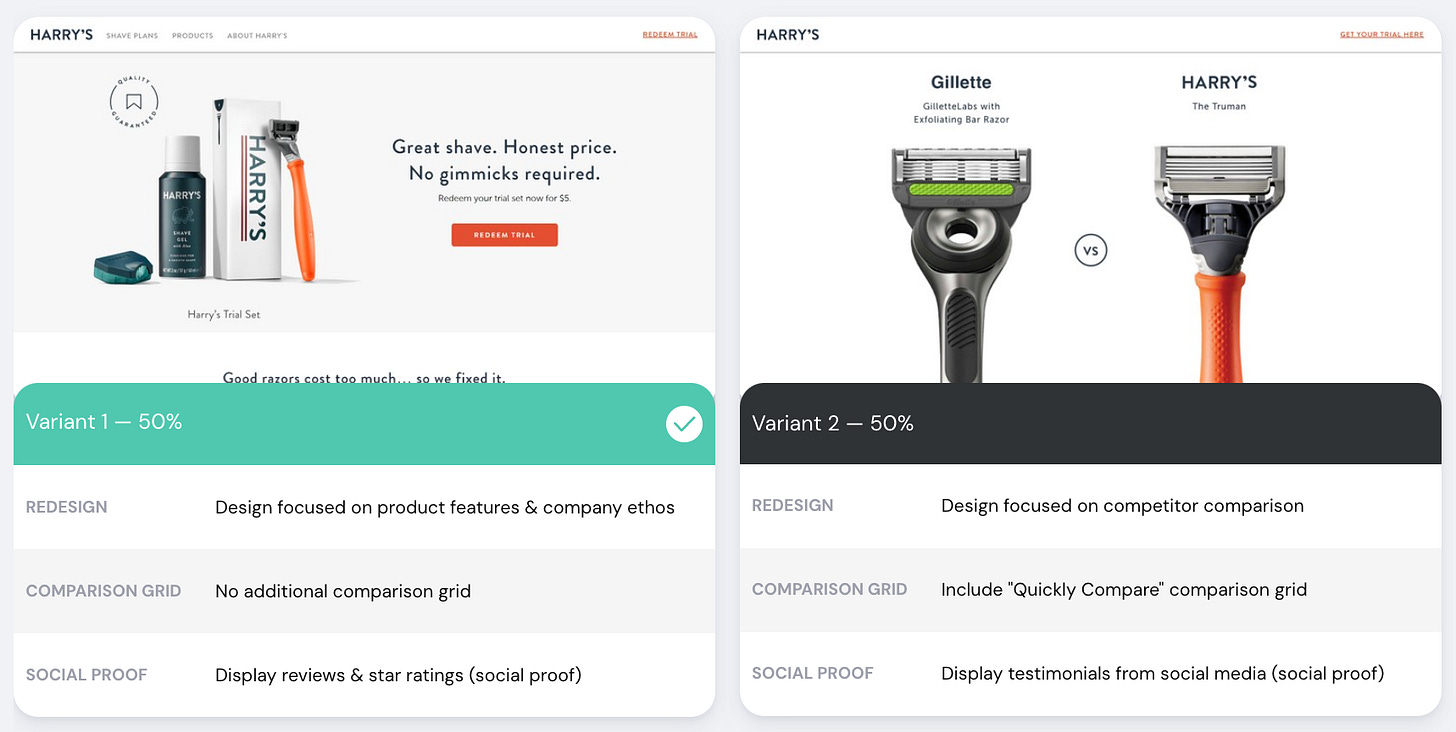
- Harry’s, for example, could test two dramatically different landing pages.
- One might make the product the hero: craftsmanship, quality, experience, materials.
- Another might frame the entire experience around comparison with the incumbent.
- Those pages can look completely different.
- But each page is still testing a recognizable idea.
- If the comparison-led experience performs better, you’ve learned something useful.
- Contrast that with a redesign where the hero changed, navigation changed, pricing changed, testimonials disappeared, a video was added, and the CTA changed.
- If performance moves 12%, what did you learn?
- Almost nothing.
- Big swings become far more valuable when you can describe the idea behind the swing in one sentence.
Find the load-bearing parts before you rebuild
- Start by identifying the parts of the experience carrying the most behavioral weight.
- That might include your:
- → navigation and information architecture
- → core positioning
- → product architecture
- → pricing presentation
- → primary offer
- → hero
- → highest-volume conversion paths
- → major trust and proof mechanisms
- Then ask a simple question about each one:
- What evidence do we have that this should change?
- Use everything available.
- → Analytics
- → Heatmaps.
- → Session recordings.
- → Customer research.
- → Sales conversations.
- → Past experiments.
- → Experimentation happening across similar companies and pages.
- The point is to understand which assumptions are strong, which are weak, and where the biggest opportunities live.
- Your redesign starts from a much better place when the team knows which parts of the current experience deserve to survive.
De-risk the biggest decisions early
- The worst time to discover your new navigation doesn’t work is two weeks after the entire new site launches.
- You can learn surprisingly much before then.
- If the redesign includes a dramatically different navigation structure, test the navigation.
- If you’re reorganizing your products, validate that architecture.
- If you’re introducing a new pricing model, learn how customers respond before baking it into forty redesigned pages.
- If you’re changing the fundamental way you explain the company, pressure-test the positioning.
- The higher the potential impact of a decision, the more useful early validation becomes.
- Sometimes that means a traditional A/B test.
- Sometimes traffic makes that impossible.
- You can still use customer research, usability studies, first-party behavioral data, experiment evidence from similar experiences or clean pre/post measurement.
- The important part is sequencing learning ahead of commitment whenever you can.
- Every major question answered before launch is one fewer variable you’ll have to diagnose afterward.
Give designers evidence while they’re designing
- This is one of the biggest opportunities to improve the redesign process.
- Designers are problem solvers.
- Give a great designer a better understanding of the problem and they will usually generate better solutions.
- So bring evidence into the creative process early.
- Analytics can show where customers are getting stuck.
- Research can reveal what they’re confused about.
- Experiment data can show which approaches have repeatedly worked or failed in similar situations.
- Then let the team explore.
- As concepts emerge, pressure-test them.
- Ask what assumptions each direction makes. Check those assumptions against the available evidence. Identify potential boulders in the road while the work is still easy to change.
- This shouldn’t feel like grading the designer after they’ve finished.
- It’s giving them better raw material while they’re solving the problem.
- It also changes internal conversations.
- When someone says, “I think this should be above the fold,” the conversation doesn’t have to turn into a taste fight.
- You can ask what customers are doing today, what previous experiments showed and what similar tests suggest.
- Evidence becomes another participant in the room.
Build a redesign operating loop
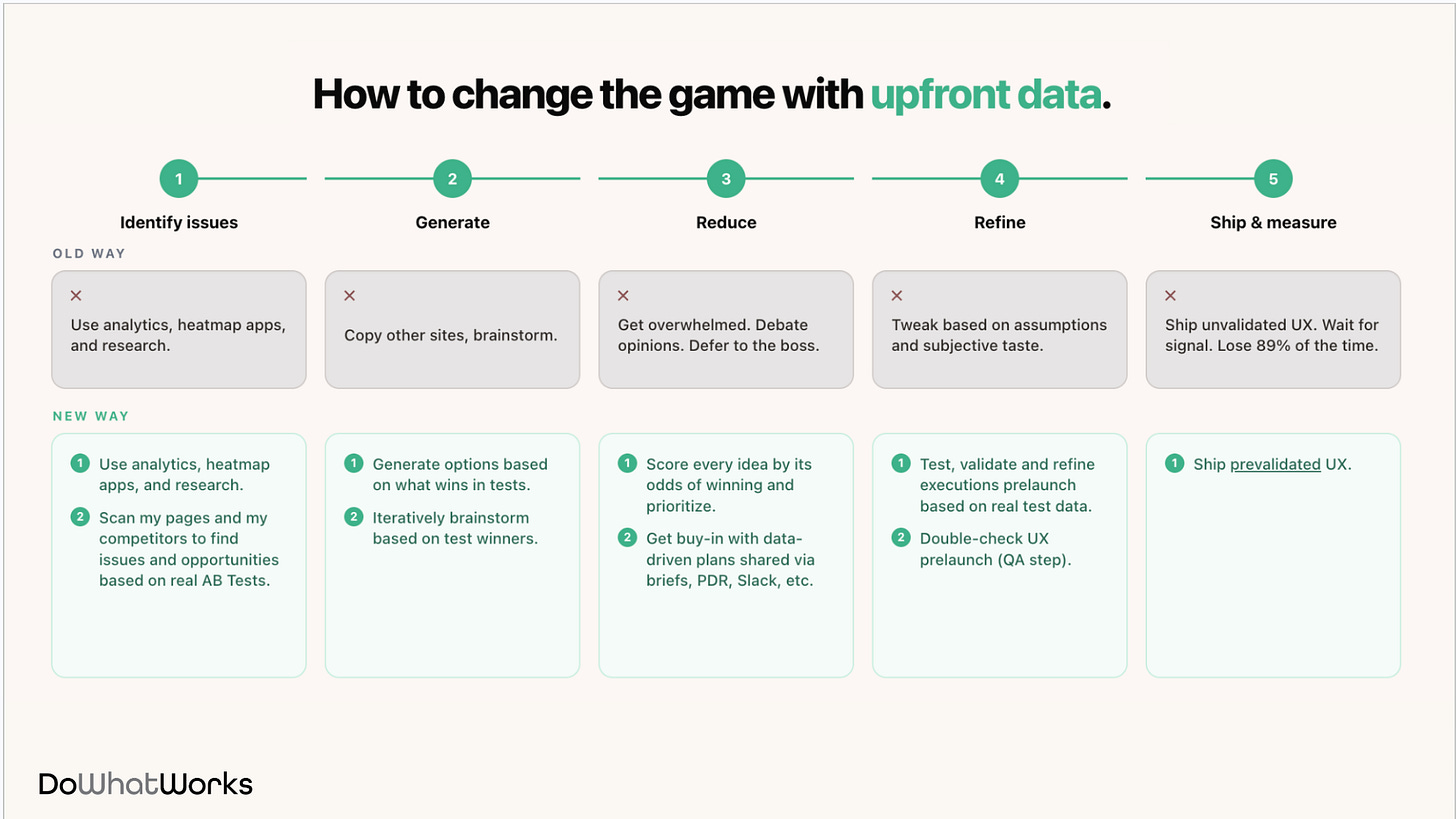
- The old redesign process often looks linear:
- Research → Design → Review → Build → Launch → Hope.
- We prefer a loop.
- Identify. Generate. Reduce. Refine. Ship and measure.
- Start with first-party evidence to locate the important problems.
- Generate larger creative approaches around those problems.
- Use experiment evidence to reduce the number of ideas you’re betting on.
- Refine the strongest concepts as new information comes in.
- Then launch with measurement already in place.
- Your analytics shouldn’t be something somebody remembers to check three weeks afterward.
- Know beforehand what you’ll watch.
- Where could customers drop off?
- Which behaviors should change?
- Which numbers should move?
- What would make you reverse a decision?
- And have possible corrections ready.
- A redesign shouldn’t end on launch day.
- Launch day is when you finally get access to the most valuable evidence of all: what real customers actually do.
What a well-run redesign looks like
- One of our customers is going through this process right now.
- The redesign was divided into a small number of core pillars rather than treated as one enormous reveal.
- New approaches were evaluated against experimental evidence while the work was still taking shape.
- Important structural changes were tested independently where possible.
- And the team planned the post-launch diagnosis before launch.
- Heatmaps and analytics will surface where behavior changes.
- Experiment data can help generate potential responses.
- The team can iterate quickly rather than spending months debating what went wrong.
- Most importantly, success isn’t defined as “conversion didn’t fall.”
- They’re trying to finish the redesign performing better than they did when they started.
The bottom line
- There are few moments when a company changes as much of its customer experience at once as it does during a website redesign.
- That’s what makes redesigns exciting.
- It’s also what makes them dangerous.
- You can replace hundreds of decisions in a matter of months.
- The strongest teams preserve the knowledge they’ve already earned, identify the assumptions worth challenging, validate the riskiest decisions early and arrive at launch ready to keep learning.
- You still get the new website.
- You just give it a much better chance of being a better website.
- At DoWhatWorks, we have over 5 years of accumulated knowledge in helping top teams relaunch their sites with no harm and substantial lifts.
- Whether you are looking for a world-class research team to stress-test your ideas with what the industry data says or you are looking for instant feedback via our agent, DoWhatWorks can help in the process.